Category Archives: God stuff

I Cried With a Homeless Man Tonight

(Written 30.January.2012)

I haven’t cried this hard since my wife’s sister passed. And I immediately desired to give this man everything I had. Yet what I had fiscally didn’t seem enough. He just knelt there, as I came out of the drugstore, and could barely get out a request for spare change. I pulled the cash I had from my wallet, walked over, knelt down, and gave it to him, asking what was wrong. He told me—in between sobs, that he had to put his dog down this afternoon. Sammie Dapple. That was the dog’s name. She was a dapple dachshund. And the man—“Boston”, blamed himself. “I should’ve had her checked every year. I just couldn’t afford it. It was all my fault.

I knelt there, holding a man I’d just met; knowing exactly the feeling he felt. I could do nothing, for I knew nothing would help. So I just held him, and cried with him, as he described Sammie and how she had little spots on her back—distinguishing marks of the breed, and cried, and talked about how hard it’s been, and cried, and how Sammie would curl up on his neck each night as he slept, and cried.

Eventually, the moment passed, and Boston went on his way, still crying, apologizing for disrupting my evening.

My evening. As if what he was used to saying to those that turned a blind eye to a man in need on a regular basis applied in this case, tonight.

A rush of emotions filled my heart, flooding my mind with thoughts and things I wished to convey. Of a love that covers all, that suffers with all, that suffers long, pursues long. Of a God who is there, who created each and every one of us specially.

Who loves us for no reason.

Created us for no reason but love.
And loves us for no reason but that we were created.

That there will be an end to all of this suffering.

That we are still being made in his image. That we didn’t screw up His plan—but that it was all part of His plan that we screw up.
That the things that keep us from Him—the shame, the blame, are necessary. For the sin that keeps us from God shows us how much He loves for no reason. For nothing of our own accord.

That there will be an end to all this. There will be a 7th day. A day of rest, when God declares it all “good.”

When a man who calls himself Boston will see the only thing that ever allowed him to experience love—a little Dapple Dachshund named Sammie, once again.

But not now.

What now?

Now all I can do is cry with him. And share with him a moment when others–when I, could’ve just walked on by.

This is the only song that has been running through my mind tonight.

I don’t know you but I want you
All the more for that
Words fall through me and always fool me
And I can’t react

You have suffered enough and what with yourself
It’s time that you won

Take this sinking boat and point it home
We’ve still got time, raise your hopeful voice
You had the choice, you’ve made it now

Falling slowly, eyes that know me
And I can’t go back
Moods that take me and erase me
And I’ll paint it black

Games that never amount
To more than themselves
Will play themselves out

Take this sinking boat and point it home
We’ve still got time, raise your hopeful voice
You had the choice, you’ve made it now

2 Comments

Filed under God stuff, Tragedy

A Funny Thing Happened on the Way to the Capital…

(Written 15.January.2012)

Stardate 41153.7. While acquainting himself with the command of his new vessel—the USS Enterprise and its crew, Captain Jean Luke Picard and three members of his crew are abducted and put on trial, representing all of Humanity for charges of “being a grievously savage race.”

In order to prove that our past should not condemn our present and future, the good Captain sets out to show the goodness—and more importantly, the progression, of Mankind to his accuser.

In the end, he proves that Humanity has indeed progressed, and will progress, but to what—as the last episode of Star Trek: The Next Generation will tell, remains to be seen.

A universe where all powerful beings who can shape and reshape the fabric of time and space, who spend all their time toying and testing with the intelligent lifeforms of the universe; a universe with beings such as these, but lacking a God, an all powerful being, and the progress of Mankind appears simply to be progression itself.

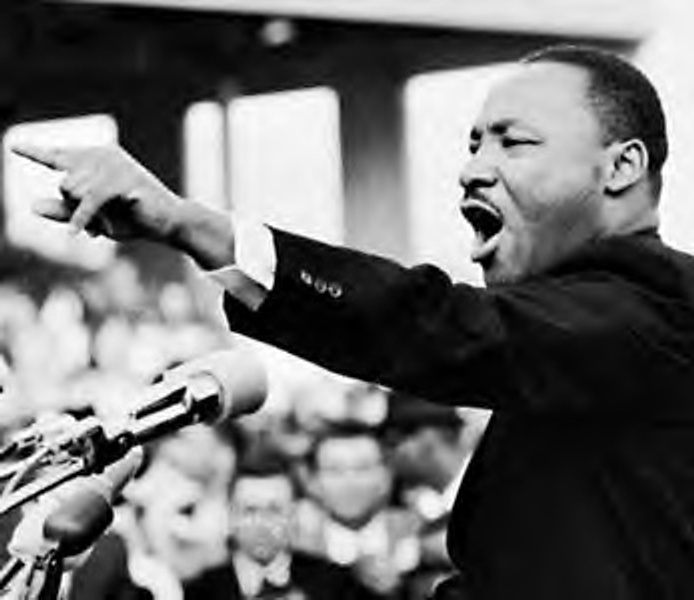
1963, a hot August day in our country’s capital, a prominent Doctor and Reverend’s speech explodes into a passionate rant about a dream; of talks of freedom, of justice.

And what was that dream?

An impossible one?

Dr. King stood, a man many believed opposed to racial discrimination. I would disagree. He stood opposed to it only for the fact that he stood for something he believed to be right—an equality of men among our nation.

He believed in an absolute right and wrong, in a manner of being that all men can reach, and he believed in a definitive, absolute, ending point of “progression.”

A right and a wrong.

It seems that the United States themselves could be considered a nation which began with the statement, “This isn’t right.”

In England, in taxation, in slavery, and what should be seen in God’s sight.

Dr. King did not say anything new, but conveyed the original, in a new way. “We hold these truths to be self evident, that all men are created equal.”

Equal in what?

Contemporarily, it seems as if what once was a fight for something right, and a nation which began by saying “This isn’t right,” has had a paradigm shift to which we modernly say, “I’m right.”

Our fight has turned from what is right, to fighting for my rights.

The government and all those disconnected from us can do as they please as long as it doesn’t impede on our rights to pursue our own individual wishes and happiness. As per my own personal feeling about it, I think, is that a nation in which all one’s wishes were fulfilled would—quite apart from disappointments, be an unpleasant nation to live in. The world would be too like a dream, and the dream too like a nightmare.

The dilemma with this has been, and will always be the absent representation of what is right.

Even in the far distant future, if man was put on trial, the only defense of wrong doing would be progression from that wrong doing.

Yet while progression from is quite clear, it the progression towards that gets murky. For if you begin with a void, to fill it with more void will leave you finding yourself fighting straw horses—of windmills, of an infinite array of human evolution, of progress, of onward and upward. And to what? Who defines human perfection when it’s based on the thing evolving itself? Did the Neanderthal expect to evolve into something superior to itself? Or no, of course not, those proponents of this would say that it hadn’t evolved to the point of recognizing progression and evolution.

For those that believe this, I would posit that what’s to keep us from evolving to a place where we recognize a mystery outside of ourselves that judges just when we’ve reached the end of the road? What’s to say we won’t progress right out of progressive thought?

At least under the frame of a Creator God, there is a clear vision that there is something which “ought” to be. Even if by Creator God you mean to say, “Some great mysterious force which can only be known by making itself known.”

But to say there is nothing at all is to say there is nothing to fight for—save for the right to fight, to progress, which—time may prove to be no right at all. To have a hint at something outside, though it may remain a mystery—nay, the mystery, is to say there not only is a purpose, but a right way of things—and by consequence, a wrong way of things, and thus, something to strive for, and to fight against.

Dr. King seemed to understand this fact. His famous speech is riddled with Spiritual references to a Creator God not because he was a Reverend, nor because he thought it would help drive home the point of the movement, but because they were so intertwined that the lines separating them could not be easily discriminated.

I’d love to be in the hope that the reason there has been none like him since is that all the great causes to fight for have been, and been won. But with Gay Rights, Occupations, Ron Pauls, Tea Parties, and the like, I don’t know how verily that can be claimed. So where has this disconnect come? Why are there no more great Civil Rights movements when it still feels as if Civil liberties still have something to be desired?

What’s lacking before we march on the Capital once more?

What vanished on our way to the Capital?

Could the divine we’ve “fought” to progress past, beyond, be the very thing which progression herein depends?

Here again it seems obvious that all the doubts which legitimately attach to the idea of a progressive humanity are absolutely fatal to the idea of progressive divinity. If the goal, the divine (Kantian humanity) to progress towards is the infinite road of progression itself, you have nothing to judge what is the right road or not.

A man may be progressing from a wrongness to God, provided there’s some faith in the divine, but what is a progressive God progressing towards?

What defined the Civil Rights movement of Dr. Kings contemporary was not just that all men are equal Constitutionally, but all men are equal in a way which far transcends any government document—in that all men are equally created by God, and in the faith of God as Father, none of his children—nor his creation for that matter, has earned the right to be stripped of liberty, of freedom, and of justice.

This is not to say that persecution was something to fight against, but King would say to fight through.

“And some of you have come from areas where your quest — quest for freedom left you battered by the storms of persecution and staggered by the winds of police brutality. You have been the veterans of creative suffering. Continue to work with the faith that unearned suffering is redemptive. Go back to Mississippi, go back to Alabama, go back to South Carolina, go back to Georgia, go back to Louisiana, go back to the slums and ghettos of our northern cities, knowing that somehow this situation can and will be changed.”

Dr. King saw persecution—tribulation, as a worthy battle to fight through, all the while resting in the hope of something greater.

It was better for him to admit a limit of freedom in existence, if only to be free to progress towards something true, than it was to have the “freedom” to flounder in whatever way “the progression of mankind” deemed appropriate.

Sometime during the Spanish Inquisition, Miguel De Cervantes stood trial amongst his fellow inmates, merely because—well, because no one enters or leaves this or any prison—without being tried by his fellow prisoners.

His charge: being an idealist, a bad poet, and an honest man.

His plea: guilty of all charges.

Of being an idealist, yes; for he never had the courage to believe in nothing.

His defense, to spin a tale of a knight so daft that he fought what others could not see, for a cause which others did not believe in.

Progression?

Yes.

For the sake of itself?

No.

The knight strove to reach the unreachable star.

There was a goal, there was an end; no matter how daft it seemed to reach for it. No matter how hopeless, no matter how far, to fight for the right without question or pause;

to be willing to march into hell for a heavenly cause!

Time may be the only thing to prove man right or wrong. We may progress to a time of starships, and of contact with sentient extra terrestrial beings; of aliens who have progressed themselves to a life of logic and suppression of emotion, to explore new worlds and strange civilizations; yet time will still be the Geiger of measurement if there is no God, if the divine is ever progressing as we are, if the cause is to move past the past, and on toward the future, time will prove man right or wrong. For who knows what mysteries one may discover, come the future of knowledge, of progression?

Will men like Hitler actually be proved right in his actions? Will Gahndi be proved wrong? Will the future’s heroes of the past sift and waver between the moral boundaries we at present hold them in?

Time may be the only thing to prove man right or wrong. But perhaps man—man may become the only thing to prove God right or wrong—or rather, to prove there even is a right and a wrong.

Materialism says that the universe is mindless; and faith says it is ruled by the highest mind. Neither will be satisfied with the new “progressive” creed, which declares hopefully that the universe is half witted.

In the end though, I would rather fight for the right (without question or pause), than for my rights.

For when this happens—when all fight for what is right, external to themselves, I believe,

“…when this happens, when we allow freedom ring, when we let it ring from every village and every hamlet, from every state and every city, we will be able to speed up that day when all of God’s children, black men and white men, Jews and Gentiles, Protestants and Catholics, will be able to join hands and sing in the words of the old Negro spiritual:

Free at last! Free at last!

Thank God Almighty, we are free at last!”

Leave a comment

Filed under God stuff, Political (as such)

My Imaginary Friend, Named “God”

(Written 9.October.2011)

When I was really young I had a best friend named Sean. We were about the same age, blonde haired, blue eyed; and considered each other like brothers. See I was the youngest of three children—I have twin older sisters 4 years my superior. Sean, I don’t know. But the point is that we were both in need of familial, brotherly type relations given circumstance.

Here’s a picture of us:

Adorable, right?

Well as sometimes happens, friends move away; which is exactly what happened with Sean.
Sure, I found new friends (I’m great at making friends; keeping them on the other hand…not so much), and I’m assuming that so did Sean; but there was still a void left by his absence. So I began to imagine he was still around.

And so began my first experience with imaginary friends. Sean was there, but real Sean didn’t know about it. And while ‘Imaginary Friend’ Sean was based on a lot of what I experienced of the real Sean, I expanded on him; making Imaginary Sean what I would have not only wanted of Real Sean, but of a friend in general. We became, in fact, brothers, Imaginary Sean and I, confidants, and Imaginary Sean was always supportive of my childhood antics and schemes.

Funny thing is when I finally met Real Sean years later, I had found that I actually preferred Imaginary Sean over the real thing. He was a better Sean to me.

Well so, years past and I found that I had developed a new imaginary friend; this one I called “God.” I’m sure a lot of us might have created the same friend, and many of the traits of our imaginary friends might even line up: Creator of the Universe—EVERYTHING, really; sustainer; go to for problem solving; who we “give” our problems to; and most importantly, “works all things to the ‘good’ of those who ‘love Him’ and are ‘called’ according to His purpose.” I mean, sure, much like Sean, I built up a friend based not only on what I’ve learned about, but also have experienced personally; yet…truth is, my friend God is just as imaginary as my friend Sean (the Imaginary version, not the Real version).

Therefore, I decided that I didn’t believe in God anymore.

Not the one I can create, craft, control, anyway.

Do I even know the real one?

Does anyone?

Well, on a side note, people used to believe that what we call reality was anything we could touch, smell, taste, hear, and see. It has only been in recent history—from microscopes to macroscopes that we’ve learned that information acquired solely from our sensory inputs accounts for only a small fraction of what can be considered ‘reality.’

It’s true.

I know this because I took a physics 101 course in college.

Now, my undergrad was Philosophy, not science, but what that tells me is that even though we can do the Scientific Method and find out all sorts of stuff about the known world, there’s still a lot of…stuff that we don’t know that may be more real than we can fathom.

What if something were more real than ‘reality’? Could it appear to have the same properties as something less real–ethereal almost in appearance but nevertheless, more real than reality? What would that make us?

Would we then become the ethereal material? Would we become the imaginary friends?

You know in many ways I’ve become an atheist lately. I’ve given up knowing the imaginary. Even myself.

What do you call an atheist who doesn’t believe he is real?

At the end of each of the Gospels, God dies.

And yet it’s still included in the story. Like it’s somehow important and ‘Good News’ that God is dead.

In John’s Gospel, Jesus just shows up Sunday night after one Hell of a weekend, and most importantly, dying on Friday.

“On the evening of that first day of the week, when the disciples were together, with the doors locked for fear of the Jews, Jesus came and stood among them and said, ‘Peace be with you!’ After this he showed them his hands and side. The disciples were overjoyed when they saw the Lord.” (John 20: 19-20)

Well, so Jesus came through doors locked for fear. Like, he just appeared. Out of nowhere.

Or maybe it wasn’t nowhere.

Maybe he appeared out of everywhere.

Into our nowhere.

And freaks us out. For we thought God was dead.

And, and maybe, just maybe, we’re scared because either God’s ethereal and able to mysteriously appear and walk through walls and been seen after death; or, we’re more scared because maybe we’re the ones that are ethereal, we’re the ones that are imagined, we’re not as real as we think and when reality comes into imaginary it can pass through walls and show up wherever it wants because it’s all part of the ‘Creators’ imagination and the Creator can show up anywhere and do anything because it’s His created world, His imagined world.

But then he shows his wounds. And the imaginary world and what takes place in it sort of blends with the real one.

Maybe even to the extent that the imagineer allows the imagination to kill the reality so that it can connect the imaginary to the real, kind of like a door, or a way; a way from imagination to reality.

I’ve seen a lot of cheesy science fiction to know that anything becoming ‘real’ hurts. It’s never a simple process of putting material to immaterial. And usually, just usually, it involves death.
Something’s death.

In Frankenstein, the monster is created by a crafting together of dead parts. All those people that made up Frankenstein’s monster had to die first before he was created. And it was no easy process to do so either.

A running theme in my life lately has been the impossibility sometimes to distinguish between the act of creation and the act of destruction. And more than that, it’s regularly the case that something must be destroyed for something else to be created. Often enough, the two can look so similar that the only way of knowing if someone is creating or destroying is to know the person.

But what if the thing destroyed isn’t real, what if it’s the imaginary? Can it still be a thing destroyed? Well it can if the real thing comes into its place. As much as I imagined ‘imaginary’ Sean to be real, the imaginary was dispelled once the real Sean showed up.

The question is, do we want it?

Or do we prefer the imaginary over the reality? Especially if we discover we’re the imaginary, we’re the product of an imagination.

I often find myself agreeing with Atheists over the disbelief in “God.” For I have felt that disbelief myself.

I’ve said to God, “I don’t know you.”

Though the more I think on that statement, the more I am forced to realize that it isn’t about me knowing God. But rather the opposite, really. It’s about God knowing me. I mean, even Jesus said in Matthew that there will be those that he will say to, “depart, I never knew you.” It’s like reality knowing us–truth knowing us, Jesus KNOWING US is far more important, than us “knowing” it–Him.

After all, if I’m imaginary, the more I’m known the more real I become. And the more real I become, the more I know reality.

If I had let go of Imaginary Sean, no matter how awesome I made him out to be, I would have been able to get to know the real Sean.

And when I stop believing in my Imaginary God, no matter how ‘real’ I’ve built Him up to be, when I become an Atheist in regards to my imaginary friend, the more I allow myself to experience the real God. Not only that, but the more want to know the real God.

So I’m an Atheist. I don’t believe in the God I’ve constructed, the God of my imagination.

But I’m ready to meet the real God.

No matter how scary. Because the real God shows up when I lock myself away in fear. Fear of what could happen to me, but also fear of the real God.

The real God scares me by showing how imaginary my reality is, then says “Peace,” and then shows me his hands, his side, his wounds, his Way for me to know Him.

And I become real; not by knowing reality, but by reality knowing me.

Leave a comment

Filed under God stuff